

These blogs are brought to you by Andy McVittie, also known as Process Physiotherapy
The following information is provided by Andy McVittie, MCSP (Member of the Chartered Society of Physiotherapists), a professional physiotherapist who is not part of the Depot Climbing group. Andy is a HCP (Health Care Professions Council) registered PH118769.
The aim of this blog series is to give advice, education and practical tips that build into a useful resource we can all use to stay injury-free.
The essence of the blogs is that every action has a consequence. Whether this is overall positive or negative is down to you; these blogs will give you the tools to make the right decision.
Let’s start with the most obvious body part…let’s talk about finger care.

Fingers

As climbers, we ask an awful lot of our fingers. They are compressed, stretched, twisted, jammed into cracks and subjected to all sorts of forces, which is why finger care is so important.
Fingers account for around 40% of all climbing-related injuries. Though I’m a climbing physio, I don’t just treat fingers. Climbing spares no part of the body from risk of injury, but fingers are currently top of that list.
The only solution is to build robustness and capacity over time. We will look at how to go about this for the whole body in future blogs. But to start let’s give our fingers some TLC. What can we do to help them deal with the battering we give them?
The interventions that follow are not a replacement for sensible load management, but a supplement to them. They will not magically fix damage you have done but they can help your fingers keep the base characteristics they need for healthy performance: ranges and joint health.
Hangboards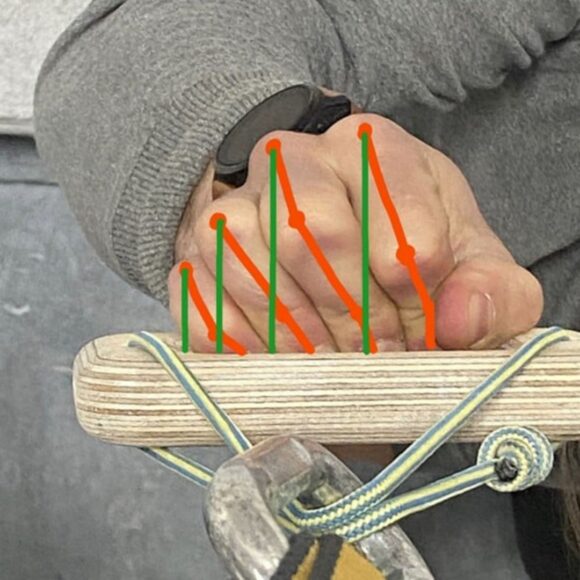

Interventions
Iron Claw
Sets: 2
Time: 30 seconds
Twice Daily.
Effort Level: as hard as you can squeeze with no symptoms
This is an exercise I give a lot in finger rehab, and many people continue to do it after rehab. It’s like tendon glides on steroids and helps keep the coordination of the finger stability mechanism, and keeps the tendons/joints healthy.
It can be done first, prior to warming up and also straight after climbing to help settle the fingers.
Instructions
Use an object that is designed to fit in the hand – a tool handle like a screwdriver or kitchen utensil is good. A pen/marker will be too thin.
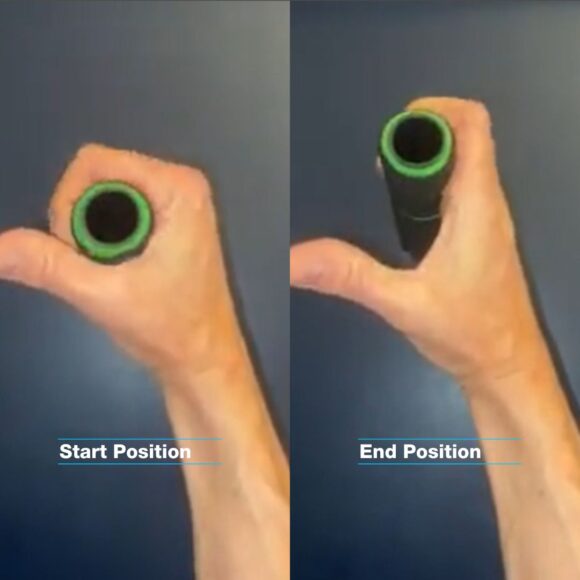
Simply squeeze with your fingers and roll the handle up and down.
- Keep the fingers actively squeezed together. Don’t allow gaps to appear between them. If you find it very hard to not gap the little finger, just use back 3.
- Keep the wrist still once it’s in position. All movement should come from the fingers alone.
- Keep the wrist straight for one set and bend it backwards into extension for the second.
- Start this with your elbow on a table, or your knee.
- Progress to having the elbow ‘free’ in the air.
- Progress further by turning the hand palm down (like a climbing position) to perform the action.
Training Accessories
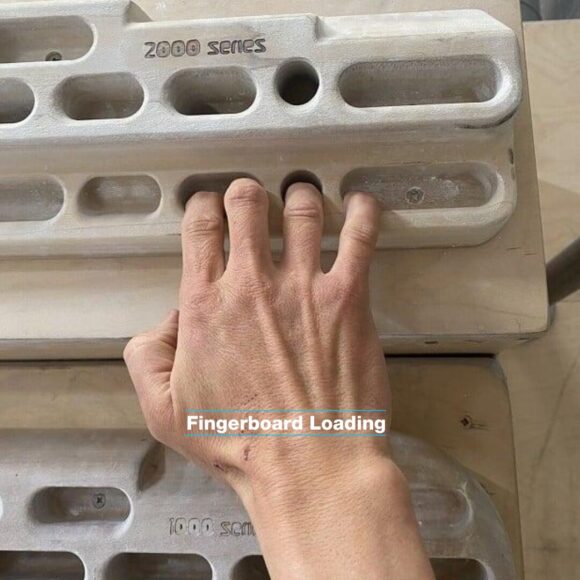
Regeneration Hangs / Minimums
Most of us know that post-climbing stiff finger feeling. It often shows itself 30-60 mins after the session (did you do your iron claws?) This is when we should do minimums.
Think of them as being like a cool down for your fingers and all the joints that get loaded further up the stream. It gets them active, the fluids circulating, transporting waste materials away, while bringing in nutritional factors for tissue health; it’s good for tendons, too.
You will likely need to have your feet on the floor, as you need to be operating at around 30-50% body weight, for short bursts. Don’t try and dangle around with 50kgs hanging off you; you also don’t need to be that accurate.
Don’t get a pulley system out. Just pull firmly, but gently. You can do this on a fingerboard, circuit board or an actual board.
You can put your feet on the floor at the base of the board. Lean back and walk around the board with your hands, moving your feet as needed. Just do 10 moves or so. Rest a minute and repeat 5 times.
Make sure you’re using finger active holds, though, not jugs.
Finger joint care routine
One-minute rest times are really annoying. Not long enough to check Instagram, have a stretch or do another exercise, but long enough that standing there staring into space gets a bit boring.
So do these:
Joint distractions
Essentially, we are going to pull the finger so the space between the bones increases, only slightly, don’t worry, and the connective tissues are stretched. This is thought to reduce the pressure within the capsule and aid the process of synovial fluid refill. I’m sure it does a bit, but I don’t think it’s refilling the tank super quickly. So don’t just do this and feel you’ve done all you need to do.
Adequate rest between sessions is the key here. But I do think these stretches help reduce ligament/capsule stiffness induced by the repetitive nature of climbing/training.
People often feel concerned about pulling their fingers apart firmly. Think about how hard you pull on them when climbing. If your fingers are uninjured, you really needn’t worry. But build up the pulling effort slowly over a few sessions if you need to.
If you have an existing finger injury, synovitis, osteo-arthritis, range restrictions and/or unstable finger joints, check with a medical professional (who understands climbing) first.
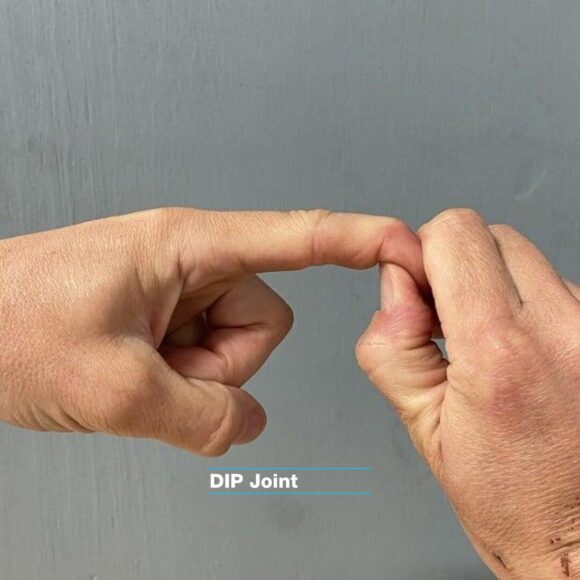
DIP Joint
- Keep the hand of the finger to be distracted, relaxed
- Take hold of the distal phalanx (end bone) of the finger as shown, and pull.
- The finger should be firmly clamped between the finger and thumb of the other hand, with the point of the thumb pushing into the crease near the joint and the end bone at a 45-degree angle.
- Pull for around 30 seconds.
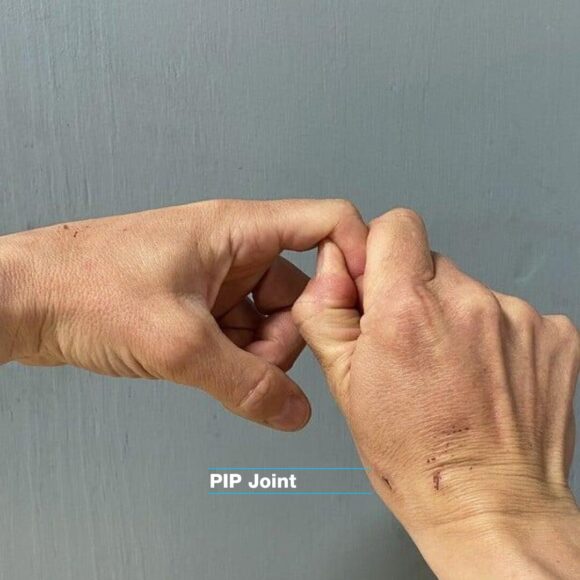
PIP Joint
- Keep the hand of the finger to be distracted, relaxed
- Take hold of the middle phalanx (bone) of the finger shown and pull
- The finger should be firmly clamped between the finger and thumb of the other hand, with the thumb pushing into the joint near the crease and middle bone at about a 90-degree angle.
- Pull for around 30 seconds.
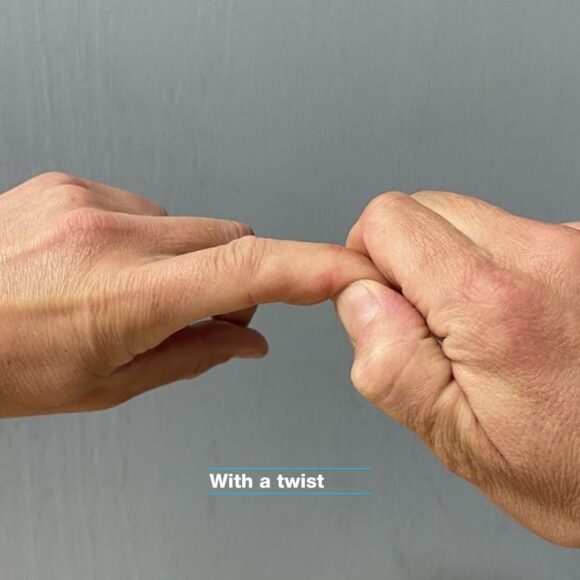
With a twist
- Take hold of the distal phalanx as shown, keep your hand relaxed, and twist.
- You can fix your hand and twist your finger with the other, or fix the hand that is grabbing and twist from the hand with the finger to be twisted, getting the same result.
- Twist for around 15 seconds each way.
I often combine the DIP joint distraction with a twist to save time.
So, this simple and effective set of exercises can be done by spending 1 minute on each finger. You can squeeze them into the minimum rest times, or do them at home while watching TV.
How do I know when my fingers are recovered enough for another session?
There is no definitive answer to this, I am afraid.
Feelings of tiredness and fatigue are what we often feel we should be chasing in training. This can have its place with muscles, but with connective tissue and joints, this is not what we are looking for. There are no muscles in your fingers. So, if they feel swollen, stiff or sore, this is a sign to consider what you are doing.
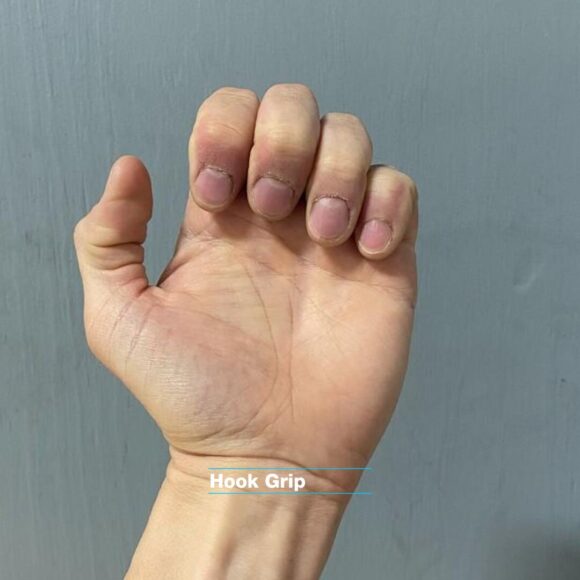
Hook Grip
A nice, quick test can be to curl your fingers into a hook grip and see how close you can get your fingers to your palm. Do this when your fingers feel good, and then you have a benchmark to compare with.
If when you bend them, they feel swollen and puffy, or tight on the side of the knuckles, these are all signs that you may need more recovery time or to change your session.
You also need to consider whether what you just did with them was appropriate.
Load Management
The best thing you can do for finger care and reduce your chances of injury and longer-term issues is to manage your overall finger load with variety and control, and maintain accessory movement ranges.
Load spikes are by far and away the biggest risk factor. If you start something new like fingerboarding, board climbing, or increase your volume, then do it SLOWLY. Plan it out to be slow progress; then make it slower.
We all kind of know this already, but I won’t apologise for repeating it, as we often don’t do it.
We’re now forming the picture that spikes can be more risky than a planned, but too fast, increase. This tends to follow two patterns in my experience:
- You get pulled along with the psyche and end up doing more than normal. Time, intensity and volume (often all 3) are variables that contribute to this. As it was ‘just one session’, we don’t think much of it. But you MUST make sure you’re fully recovered from it before you go back to your normal levels. We’ll look at how we do that and how we know in future blogs.
- Trips: You normally climb 2-3 times a week with 2-3 days between sessions. You go on holiday and climb 7 days out of 7, including the travel days. That may be a bit of an exaggeration, but I have seen it.
In summary, climbing is very hard on our fingers. The best thing you can do to reduce injury is to be careful with increasing loads in any form, avoid spikes, and gradually build robust fingers over time.
Build in a little finger care at the end of every climbing session and on rest days to reduce joint stiffness and aid recovery. Your fingers will thank you for it!
Process Physiotherapy
Andy McVittie has been climbing for 30+ years, coaching for 20 and is a full-time climbing physiotherapist who practices as Process Physiotherapy.
Using this experience, Andy has a deep understanding of how to treat climbing injuries without the need to fully stop climbing. Blending rehab advice with climbing, training and plans, Andy works with climbers to help you get back stronger and more robust for your future climbing career.
Andy is also the author of the best-selling ‘The Self-Rehabbed Climber‘. A must-have for any keen climbers bookshelf.
Andy also hosts sessions at BIG Depot Manchester on Thursdays between 07:30 – 19:00, and Saturdays between 10:00 – 17:00.
Categorised in: Tips
This post was written by depotadmin