

These blogs are brought to you by Andy McVittie, also known as Process Physio
This blog series aims to give advice, education and practical tips that build into a useful resource we can all use to stay injury-free.
The essence of the blogs is that every action has a consequence. Whether this is overall positive or negative is down to you; these blogs will give you the tools to make the right decision.
This edition discusses autoregulation and RPE. Basically, how not to train like a robot…
Picture this: you drag yourself to the climbing wall after a week that felt like a boss fight. You’ve slept terribly, work has melted your brain, and your finger is still whispering, “Please stop.”
You run through your usual warm-up benchmarks… and miss all of them! Uh oh…
You start climbing anyway because you’ve got a trip coming up and a beautifully colour‑coded, scientific, periodised training plan that cost actual money. Tonight is linked boulders. So obviously, you must make it happen.
Except you can’t. You’re failing halfway through set two, your finger is sulking, and you’re convincing yourself that “trying really hard and failing” equals “great training.”
The next day? You’re exhausted, demotivated, and your finger feels like it’s been hit with a hammer. No training for days. Disaster.
We’re not machines
Humans fluctuate. Energy, stress, sleep, soreness—none of it is linear. Training that ignores this reality is basically an injury subscription service.
Enter autoregulation.
But what is autoregulation?
Adjusting your training in real time based on how you’re actually performing, not how you wish you were performing.
What is RPE?
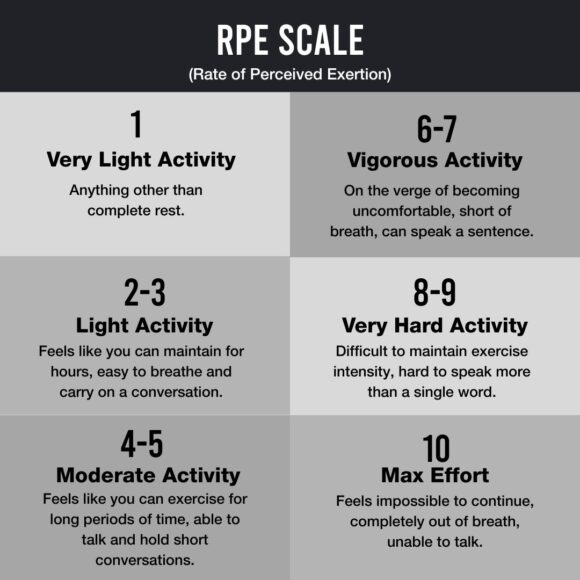
Rate of Perceived Exertion = how hard something should feel and how hard it did feel.
Rate of Perceived Exertion Scale
1: Very Light Activity
Anything other than complete rest.
2-3: Very Light Activity
Feels like you can maintain for hours, easy to breathe and carry on a conversation.
4-5: Moderate Activity
Feels like you can exercise for long periods of time, and are able to talk and hold short conversations.
6-7: Vigorous Activity
On the verge of becoming uncomfortable, short of breath, but are able to speak a sentence.
8-9: Very Hard Activity
Difficult to maintain exercise intensity, and hard to speak more than a single word.
10: Max Effort
Feels impossible to continue, completely out of breath and unable to talk.
It’s your internal “effort-o-meter.”
It doesn’t tell you what grade to climb—it tells you what effort zone to hit. You adjust the variables (grade, reps, sets, rest) to match the target.

Why utilise this?
Because guessing whether 4×6 should feel easy or like a near-death experience is a terrible strategy.
We want the minimum effective dose—enough stress to adapt, not enough to break.
But what’s a 10/10 anyway?
Think Eddie Hall deadlifting himself into a nosebleed and temporary unconsciousness. That’s a 10.
You don’t need that.
A 9 is a performance level—save it for special occasions.
Most training should live around the 6–8 zones.
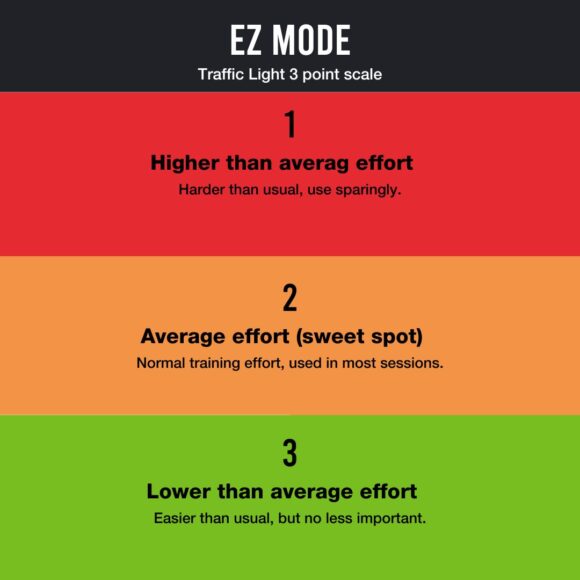
To start using the principle in an easy-to-manage way, you can keep it simple.
1: Higher than average effort
Harder than usual, use sparingly.
2: Average effort (the sweet spot)
Normal training effort, used in most sessions.
3: Lower than average effort
Easier than usual, but no less important.
Back to our climber…
Linked boulders are meant to be hard. However, if your normal V4 flash grade feels like a 9/10 today, consider dropping to V3 to achieve the planned 8/10. Your body responds to effort, not grade.
Your ego, however, responds only to grade, so ignore it! If you feel better mid-set? Add a harder problem. Feel worse? Drop a grade.
Autoregulation = constant tiny adjustments to stay in the right zone.
Track it!
Write down:
- The planned RPE
- The actual RPE
If they don’t match, adjust the next session. Otherwise, what’s the point?
A simple, more objective example: Deadlifts
- Session 1: 5×5 @ 100kg = RPE 8 → great.
- Session 2: You’re tired → 5×5 @ 90kg = RPE 8 → still great.
- Session 3: You feel good → 5×5 @ 105kg = RPE 8 → excellent autoregulation.
- Session 4: You feel “meh” but force 100kg anyway → RPE 9 → wiped out → miss next session.
That’s failing to autoregulate.
Return to the top of this article and try again.
Process Physiotherapy
Andy McVittie has been climbing for 30+ years, coaching for 20 and is a full-time climbing physiotherapist who practices as Process Physiotherapy.
Using this experience, Andy has a deep understanding of how to treat climbing injuries without the need to fully stop climbing. Blending rehab advice with climbing, training and plans, Andy works with climbers to help you get back stronger and more robust for your future climbing career.
Andy is also the author of the best-selling ‘The Self-Rehabbed Climber‘. A must-have for any keen climbers bookshelf.
Andy also hosts sessions at BIG Depot Manchester on Thursdays between 07:30 and 19:00, and Saturdays between 10:00 and 17:00.
Categorised in: Tips
This post was written by depotadmin